The GenomeComputer Company
INTRODUCINGThe Genome API

Your Genome.Sequenced, annotated, and ready to explore.

We are a Public Benefit Corporation dedicated to empowering individual self-understanding.

Currently sequencing and annotating 1,000 genomes

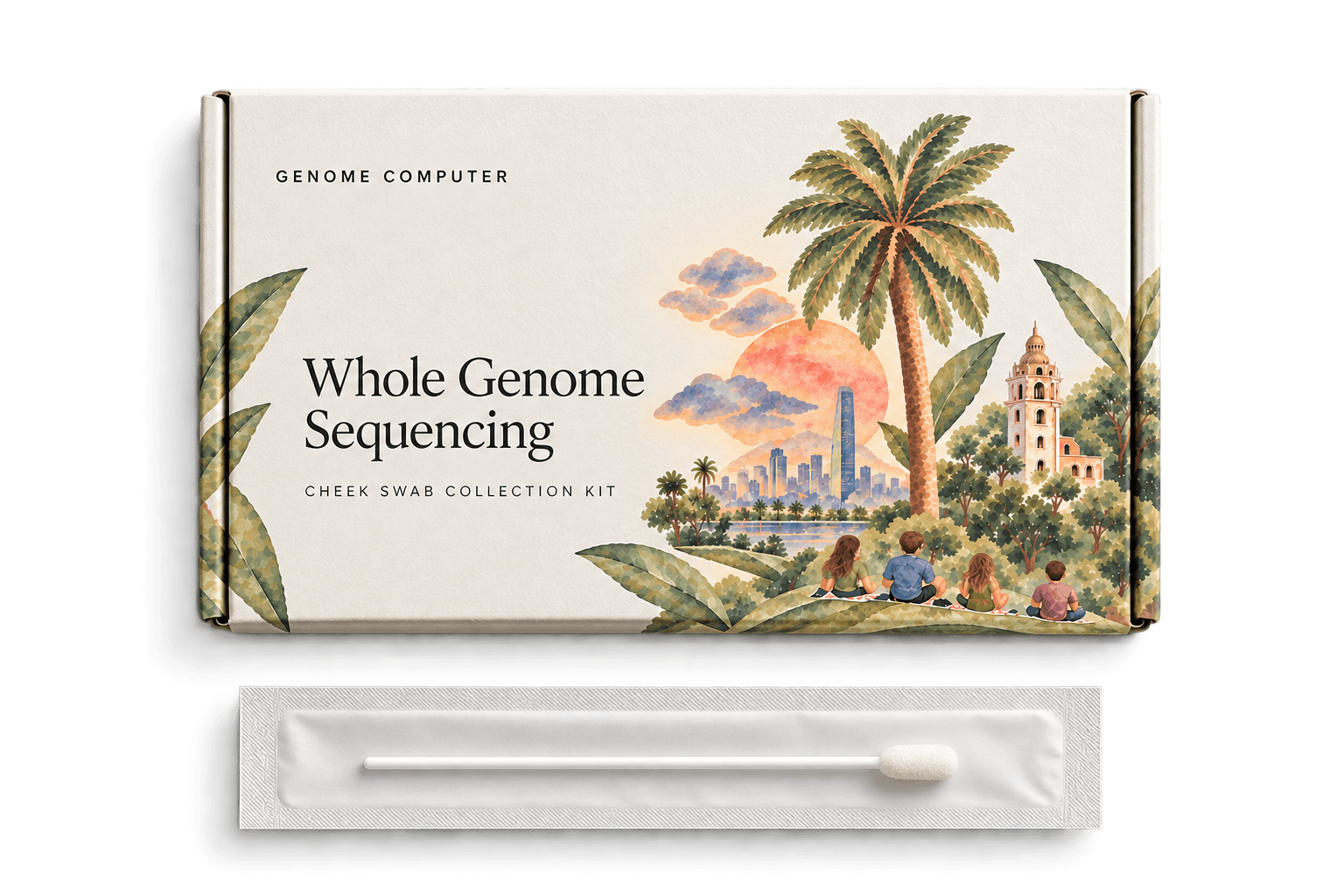
Order your genome

Get a fully annotated .genome bundleThe open, AI-ready format we developed for genome data. Yours to download, keep, and explore. for you to explore your genome with Codex, Claude Code or any tool of your choosing. gVCFUnlike the VCF files legacy providers deliver, a gVCF preserves both your genetic variants and the confidently sequenced regions between them, making your genome more useful for future analysis. and FASTQA FASTQ file contains the raw DNA sequencing data exactly as it comes off the sequencing machine. available on request.

CONSUMER GRADE

Whole genome, 3x

$299

An accessible foundation for everyday genetic intelligence that updates as new research advances. 2-3 week turnaround.

  • Access to Genome IntelligenceWe re-annotate your genome every month as research advances, and send you the latest genetic insights and prompts you can run against your own genome. for $15/month (cancel anytime)
  • readmygenome.md skill
  • Download and self-host
  • Data deleted by default
Order now
CLINICAL GRADE

Whole genome, 30x

$599

The complete foundation for lifelong genetic exploration. 2-3 week turnaround.

  • Access to Genome IntelligenceWe re-annotate your genome every month as research advances, and send you the latest genetic insights and prompts you can run against your own genome. for $15/month (cancel anytime)
  • readmygenome.md skill
  • Download and self-host
  • Data deleted by default
Order now
Research Grade

Whole genome, 100x

$1,499

Ultra-deep coverage for advanced exploration, rare variant discovery, and research-grade analysis. 4-6 week turnaround.

  • Access to Genome IntelligenceWe re-annotate your genome every month as research advances, and send you the latest genetic insights and prompts you can run against your own genome. for $15/month (cancel anytime)
  • readmygenome.md skill
  • Download and self-host
  • Data deleted by default
Join batch3/18 spots filled
Complete privacy protection

Private whole genome, 30x

$699

The complete foundation for lifelong genetic exploration delivered with full privacy protectionPrivate ordering is designed so we never need to know who you are and all data linked to your order is deleted upon delivery of your .genome.. 3-4 week turnaround.

  • No permanent account
  • Download and self-host your genome
  • No identifying information captured
  • All data deleted within 30 days

Genome Intelligence unavailable

Order now

Already have a DNA file? Convert it to .genome.

$99

Upload your VCF or TXT file from any sequencing provider and we'll return a fully-annotated .genome bundle ready for you to explore. Imputed where needed, VEP-annotated, PharmCAT-called, PGS-scored. .genome files use 3–10Γ— fewer tokens and are 10–20Γ— more accurate when interpreted by AI.

  • Access to Genome IntelligenceWe re-annotate your genome every month as research advances, and send you the latest genetic insights and prompts you can run against your own genome. for $15/month (cancel anytime)
  • readmygenome.md skill
  • Download and self-host
  • Data deleted by default

Your DNA stays private and remains in your full control.

We're a Public Benefit Corporation legally bound to never sell or license your individual genetic data. It's your data and always will be.

Library

Start exploring your .genome

View all

Published April 1, 2026

MEIS1 rs113851554 may shift your REM versus NREM sleep balance

University of Oxford

Check my genotypes for MEIS1 rs113851554, rs4544423 and rs182588061, plus KCNK9 rs888346. Explain the reported REM and NREM direction of effect for each variant and whether the finding relates to accelerometer-inferred sleep stages.

Published November 28, 2025

Vitamin D genes can explain why sun exposure changes levels differently

Trinity College Dublin / University of Galway

Using the 2025 vitamin D gene-environment GWAS, inspect my .genome for variants near GC, CYP2R1, PDE3B, PSMA1, COPB1, CALCB, BMAL1/ARNTL and DHCR7, including GC rs115366859 if covered. Explain whether any signal relates to vitamin D transport, synthesis, metabolism, circadian biology or UVB interaction, and summarize the lab value, season, supplement use and sun exposure context that would help interpret it.

Published September 26, 2025

RXRA and SOX9 can explain acne risk biology and retinoid relevance

King's College London / QIMR Berghofer

Using the Maxwell et al. 2025 acne GWAS, inspect my .genome for acne-associated variants or polygenic signal near RXRA, SOX9 and genes in WNT and p53 pathway annotations. Explain whether any signal is variant-level, locus-level or pathway-level, and how it relates to pilosebaceous-unit cell fate, RXRA signalling and retinoid biology.

FAQ

What do I get?
A .genome bundle β€” the open, AI-ready format we developed for consumer genome files β€” plus the readmygenome.md skill. Yours to keep, use, or archive.
What reference build do you use?
GRCh38.
What is a .genome file?

.genome is an open file format for genome data, designed to be read and interpreted by AI systems. It uses the same underlying data as a VCF, but restructures it so models can process it reliably, with clear provenance and without relying on partial parsing or guesswork.

Under the hood it's not one flat file but a structured, queryable bundle (format version .genome/1.0). Your variants are stored in fast columnar tables alongside the annotations that give them meaning β€” trait associations, the supporting research behind them, gene-level context, polygenic scores, and pharmacogenomics β€” so a tool can answer questions against your whole genome directly.

A whole-genome sequence fills it out completely (~4.3M variants); uploads from array-based tests like 23andMe or Ancestry come in smaller (~600k). Either way, it's a single portable file that travels with you.

Compared to raw VCF files, .genome reduces token usage by 3–10Γ— while reducing factual errors by 10–20Γ—.

How is this different from raw sequencing providers?

Raw sequencing providers usually deliver technical files β€” FASTQ, BAM/CRAM, VCF, or a static report. Those files are valuable, but they're hard to inspect, hard to keep updated, and not designed for AI tools to reason over directly.

Most providers tell you what variants you have. Genome Computer tells you what you have and what it means: variants, annotations, trait evidence, pharmacogenomics, polygenic scores, provenance, and prompts in one portable format you can use with Codex, Claude Code, or any tool of your choosing.

For sequencing orders, we build from a gVCF instead of only a consumer-style VCF. A VCF mostly lists the places where you differ from the reference genome. A gVCF also preserves the confidently sequenced regions where no variant was found, which helps distinguish "no variant here" from "we do not know because this position was not confidently covered."

The difference is that you're not just receiving raw output from a sequencer. You're receiving an AI-readable genome you can keep, query, re-annotate, and explore as the science changes.

What can I do with it?

A .genome file is a portable, AI-readable container for your genetic data. The point is that it travels with you and works inside any tool that can read a file, so you're not locked into one platform's interface.

Concretely, you can:

  • Drop it into an AI coding/agent tool β€” Codex, Claude Code, Cursor, or anything that can ingest a file β€” and treat your genome as queryable context. The file format (.genome/1.0) is structured so the model can parse variants, archetype data, and phenotype context directly.
  • Ask open-ended questions β€” "What does my genotype suggest about caffeine metabolism?", "Which of my variants relate to sleep?", "How should I read my stress-recovery axis?" β€” and get answers grounded in your actual data rather than generic advice.
  • Test hypotheses β€” pull in a paper or a new GWAS finding and ask the tool to check it against your specific genotypes, so you can see whether a result actually applies to you.
  • Stay current β€” re-run analysis as new research lands (ClinVar/PharmGKB updates, new associations) without re-sequencing. The same file gets re-interpreted against newer knowledge.
What's the difference between 3x, 30x, and 100x WGS?

All three are true whole-genome sequencing β€” they read your entire genome, not a fixed chip of ~650K sites like an array. The "x" is depth: how many times, on average, each position in your genome gets read. More depth = more confidence, especially on rare variants.

3x β€” reads your whole genome lightly. Confident on the common-variant layer that powers your identity, polygenic scores, ancestry, and trait insights β€” and already far beyond any array. It can see rarer variants but not yet call them with clinical confidence. A real entry into whole-genome.

30x β€” the clinical-grade standard. Enough depth to confidently call rare and pathogenic variants: carrier status, actionable ClinVar findings, full pharmacogenomics. This is "your real genome" with no imputation caveats β€” the sweet spot for almost everyone.

100x β€” research-grade, maximum confidence. Diminishing returns for everyday genomics, but it pulls ahead on the hardest cases: low-frequency and mosaic variants, structural variation, and difficult-to-read regions. The deepest, most future-proof read.

Whichever depth you choose, it converts into the same .genome bundle β€” same format, same tools. The difference is how much of your genome answers with confidence: 3x lights up your identity and trait layer; 30x adds the full clinical and pharmacogenomic layer; 100x maxes out certainty on the rarest signals.

How long does it take?
3x and 30x whole-genome sequencing typically take 2–3 weeks from when the lab receives your sample. 100x sequencing typically takes 4–6 weeks.
What about privacy?
Genetic Superintelligence Company is a Delaware Public Benefit Corporation β€” legally bound by its charter to never sell or license your individual genetic data. We don't sell your data, share it with researchers, or use it to train models. There is no "optional research program." You can request sample and data deletion after your file is delivered. All samples are deleted by our lab within 30 days. Our lab never holds PII.
How does private ordering work?

Private orders are designed so Genome Computer never needs to know your identity.

We do not create a customer account or require a permanent email address. Instead, your order is identified only by a Genome ID and Access Code generated at checkout.

Any information temporarily required to process payment or fulfil your order is used only for that purpose.

How do I check the status of my private order?
Visit genome.computer/private and enter the private access code shown when you placed your order. No account or email is required.
Can I use this for medical decisions?
No. This is raw data, not a medical test. For clinical interpretation, take the file to a physician or clinical genetics service.
Where do you ship?
We currently accept orders in the United States, Canada, the United Kingdom, Australia, New Zealand, and Singapore. If you're outside these countries, email waitlist@genome.computer to join the waitlist.
Who built this?
Genetic Superintelligence Company β€” a Delaware public benefit corporation.